
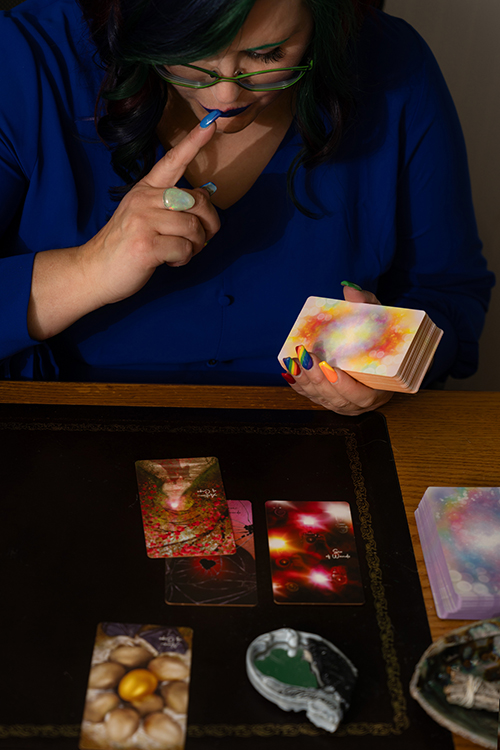

A tarot reading can be powerful.
It can bring clarity where there’s confusion. It can help you see patterns you’ve been too close to notice. It can reconnect you with your intuition, your choices & your next right step.
But a good reading does not begin when the first card is pulled.
It begins with how you prepare.
The more present, honest & open you are before, during & after your reading, the more meaningful the experience can become. Tarot is not something that simply happens to you. At its best, it is something you & your reader co-create together.
Here’s how to get the most out of your tarot reading.
Before Your Reading
Before you book or arrive for your reading, it helps to know a few things.
You’ll want to have a sense of:
- what area of your life you’d like to address
- what you hope to receive from the reading
- what kind of reading experience you’re looking for
- what style of reader you want to work with
- whether the reader’s ethics, style & specialties feel aligned with your needs
If you haven’t already, you may want to read my earlier posts on what makes an effective & ethical tarot reader, as well as how to choose one. Those will help you understand what to look for before you trust someone with your questions, your energy & your story.
And here’s something important: Please don’t assume your tarot reader is psychic.
Some tarot readers may identify as psychic. Many do not. And even when a reader has intuitive or psychic gifts, tarot is not about making them guess why you’re there, what you need or what is happening in your life.
Tarot is often less about psychic ability & more about intuition, symbolism, pattern recognition, spiritual insight, emotional awareness & interpretation.
So please don’t make your reader prove themselves by withholding important information.
No testing.
No games.
No “tell me what I’m thinking” energy.
If you want a helpful reading, tell your reader what they need to know. Share the relevant background. Explain the situation. Answer their questions honestly. Give them enough context to work with you well.
That information is not “cheating.”
It’s part of the process.
A reading is stronger when your reader understands what you’re asking, what you’re carrying & what kind of support you need.
Come With a Strong Question
One of the best ways to improve your tarot reading is to come with a thoughtful question.
Your reader should be able to help you refine it, but it helps to begin with a clear direction.
A strong tarot question is usually:
- open-ended
- focused on you
- centered on what you can influence
- rooted in the present
- specific without being overly controlling
- connected to what you want from the reading
- free of “should” or “ought” language
For example, instead of asking: “Will this situation work out?”
You might ask: “What do I need to understand about this situation so I can move forward with more clarity?”
Instead of asking: “What does this person think of me?”
You might ask: “What do I need to know about my role, needs & choices in this connection?”
Instead of asking: “What should I do?”
You might ask: “What options are available to me, and what might each one ask of me?”
Empowering questions lead to more empowering readings.
They help you focus on awareness, choice & aligned action instead of handing your power over to the cards, the reader or a fixed prediction.
If you’re having trouble finding the right question, journaling can help. Write down what’s happening, what you’re feeling, what you wish you understood & what you’re afraid to look at. Freewriting can be especially helpful because it lets your thoughts and feelings come through without forcing them into perfect language.
Your reader can help you shape the final question from there.
Choose a Reader You Like & Trust
This may sound simple, but it matters.
You need to trust your reader.
If you don’t feel comfortable with them, it will be harder to open up about personal, emotional or complicated topics. And if you don’t like their energy, style or approach, the reading probably won’t feel as supportive as it could.
Trust does not mean the reader always tells you what you want to hear.
It means they treat you with respect. They communicate clearly. They honor your boundaries. They are honest about what tarot can and cannot do. They make space for your humanity instead of trying to overpower it.
A good reader should help you feel more connected to yourself, not more dependent on them.
Create a Supportive Space
If your reading is over video or phone, take a little time to prepare your space.
Choose a place where you can be as free from distractions as possible. Silence notifications if you can. Let anyone nearby know you’ll need privacy. Bring water, tissues, a notebook or anything else that helps you feel supported.
Then create whatever kind of atmosphere helps you feel present.
For me, sacred space may include incense, music, crystals & candles. For you, it might be a cozy blanket, a favorite mug, a quiet room, soft lighting or simply a few deep breaths before the reading begins.
There is no one right way to do this.
The goal is not perfection.
The goal is presence.
Some readers begin with grounding or meditation. If yours doesn’t, you can do your own grounding beforehand. Try a short breathing exercise, guided meditation, body scan or simple practice of placing your feet on the floor and noticing your breath.
Especially if you’re a Highly Sensitive Person, Empath or someone with Chronic Illness, preparing your space can help your nervous system settle enough to actually receive the reading.
Release the Need for a Specific Answer
This one can be hard.
Many people come to tarot because they want certainty. They want to know what will happen. They want the cards to say the thing they secretly hope is true.
But tarot is not at its best when it is treated like a certainty machine.
Tarot illuminates patterns, possibilities, choices, blocks, invitations & truths that may be ready to rise to the surface.
That means the reading may give you what you need, not necessarily what you wanted.
- It may affirm something you already knew.
- It may challenge an assumption.
- It may reveal a pattern you hoped wasn’t there.
- It may show you an option you hadn’t considered.
- It may ask you to reclaim power you didn’t realize you had given away.
The more open you are, the more you’ll be able to receive.
Try to enter your reading with curiosity instead of control.
Ask Questions Before the Reading
If you have concerns, ask them before your session.
You can ask during a discovery call, over email or through whatever communication method your reader uses.
You may want to ask:
- What kinds of questions do you answer?
- Do you record sessions?
- Can I ask clarifying questions?
- What happens if something doesn’t resonate?
- Do you offer follow-up clarification?
- What topics are outside your scope?
- How do you handle confidentiality?
A good reader won’t be offended by thoughtful questions.
In fact, clear communication before the reading often makes the reading itself stronger.
During Your Reading
Once the reading begins, be present.
Listen to the reader. Listen to the cards. Listen to yourself.
Be open to the process, especially if your reader helps you refine your question, invites your input or asks what a card brings up for you.
This is part of what makes tarot collaborative.
You are not just sitting there receiving information. You are participating in the meaning-making process. Your reactions, thoughts, body sensations, emotions & intuitive hits all matter.
Be Honest
Honesty is essential.
If something is relevant, say so. If the reader asks a question and you know the answer, share it. If there’s context that would help the reading make more sense, offer it.
This doesn’t mean you have to share anything you’re not ready to share.
But it does mean that withholding important information to “test” the reader can weaken the reading.
Tarot works best when there is trust, openness & collaboration.
Your truth gives the cards somewhere to land.
Listen Actively
A tarot reading can hold a lot of information.
The reader may talk about card meanings, patterns, themes, symbols, emotions, choices & possibilities. It can be a lot to take in all at once.
If your reader records the session, revisit the recording later. If they don’t, ask whether you may record it yourself. If recording isn’t an option, take notes — though it can be harder to stay fully present while writing everything down.
Active listening helps you stay connected to the reading as it unfolds.
Pay attention to what lands immediately. Also notice what doesn’t land yet, but seems important. Some insights need time before they make sense.
Speak Up If Something Doesn’t Resonate
You do not have to silently accept everything a reader says.
If something doesn’t resonate, say so.
A good reader should be able to pause, revisit the card, ask a clarifying question or explore a different angle. Sometimes the interpretation is slightly off. Sometimes the application needs adjusting. Sometimes the insight simply hasn’t shown up in your lived experience yet.
And sometimes, gently, something inside you may not be ready to see what the card is pointing toward.
That doesn’t mean you should force yourself to accept everything.
It means you can stay curious.
You might say:
- “I’m not sure that fits yet.”
- “That doesn’t feel quite right.”
- “I can see part of that, but not all of it.”
- “Can we look at that another way?”
- “I think I need more clarity there.”
A reading should have room for your voice.
Ask for Clarification
If something is unclear, ask.
Your reader may be able to explain the card differently, connect it back to your question or pull a clarifying card if that is part of their process.
Clarifying cards can help deepen the message, provide context or show what needs more attention.
You are allowed to ask questions.
You are allowed to need a moment.
You are allowed to say, “Can we stay with this part a little longer?”
Trust Your Intuition
Your intuition is part of the reading, too.
Notice what you feel before, during & after the session. Pay attention to the words, images or card meanings that stay with you. Notice where your body softens, tightens, warms or pulls back.
Sometimes the most important part of a reading is not what the reader says.
It’s what wakes up inside you when they say it.
If you struggle to tell the difference between intuition, anxiety, fear or ego, bring that into the conversation. A thoughtful reader may be able to help you explore what your inner knowing feels like compared to panic, pressure or wishful thinking.
This is especially important for sensitive people, who may absorb so much from the world around them that their own inner voice becomes harder to hear.
A good tarot reading can help you find your way back to that voice.
After Your Reading
The reading does not end when the session ends.
Often, the real integration begins afterward.
If your reader allows follow-up clarification, make sure you understand their policy. Some readers may answer a brief follow-up email. Some may pull an additional clarification card or two. Others may not offer follow-up outside the session.
Know what is included before you book so there are no surprises later.
Revisit the Reading
If you have a recording, listen to it again.
You may notice things you missed the first time. Something that didn’t make sense during the session may land differently a week later. A message that felt small may become more important once you’ve had time to live with it.
You can also journal after the reading.
You might write about:
- what stood out
- what surprised you
- what felt affirming
- what felt uncomfortable
- what you want to explore further
- what choices now feel clearer
- what action you may want to take next
Journaling helps move the reading from information into integration.
Look for Themes in Your Life
After the reading, pay attention.
Notice what themes show up in your relationships, work, body, emotions, intuition or daily choices. Watch for patterns that echo the cards. Notice what keeps repeating. Notice what feels newly visible.
Then ask yourself:
- What can I do with this insight?
- What choice is mine to make?
- What behavior might need to change?
- What boundary might need to be honored?
- What support might I need?
- What truth am I ready to stop avoiding?
A tarot reading is not meant to replace your choices.
It is meant to help you make them with more awareness.
Prepared Readings Go Deeper
You can absolutely show up to a tarot reading without having everything figured out.
You don’t need perfect language. You don’t need a polished question. You don’t need to understand your entire situation before the cards are pulled.
But preparation helps.
When you know what you want to explore, choose a reader you trust, ask honest questions, stay open during the session & reflect afterward, you give the reading room to become more than a moment of insight.
You give it room to become a turning point.
If you’re a Highly Sensitive Person, Empath or person with Chronic Illness who wants a tarot reading rooted in intuition, ethics, collaboration & transformation, I’d love to work with you. Please check out the services I offer at www.intotheaviary.com/offerings/.


